
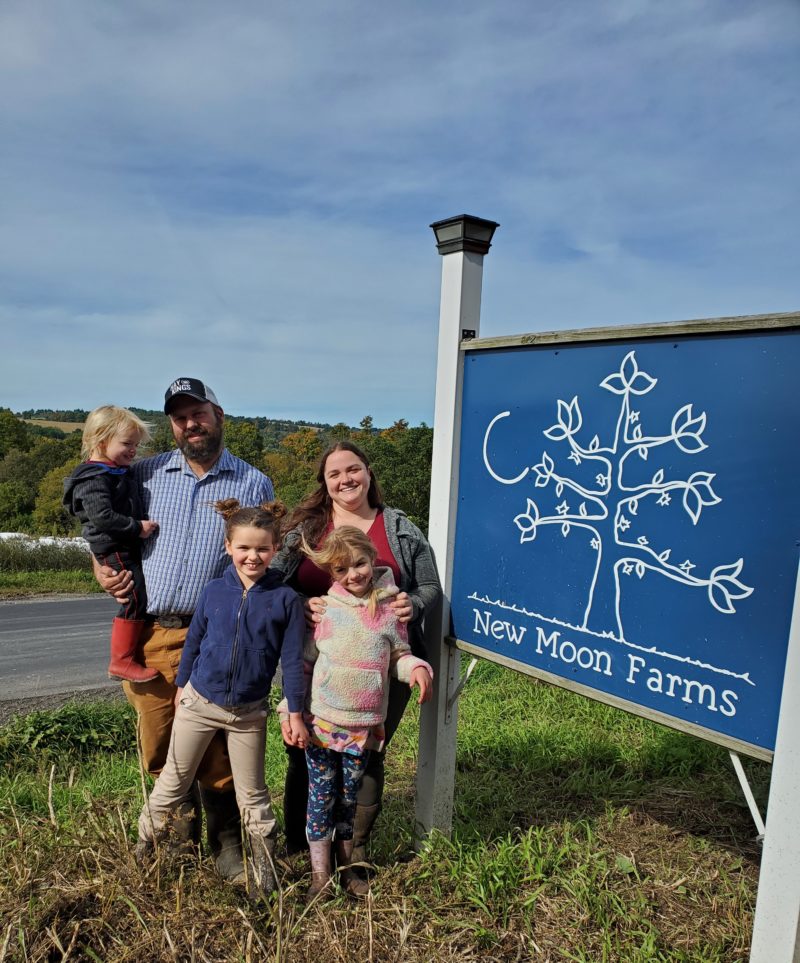
Dairy Climate Adaptation and Mitigation Fellow, Sarah Ficken, gained a wealth of new knowledge even as a project leader.
Sarah Ficken works in the dairy industry both as a farmer and as program manager for a diary training program in New York (NY). She is also on the leadership team for the Dairy Climate Adaptation and Mitigation Fellowship (Dairy CAMF). Even as a member of the Dairy CAMF leadership team, Sarah still learned a great deal about how to prepare her farm for extreme weather events. Sarah and her husband, Chris, run a first-generation farm, New Moon Farmstead, in Munnsville, NY. Their farm is highly diversified, featuring dairy, beef, pigs, chickens, and additional livestock. Since 2023, Sarah and Chris have primarily focused on beef rather than milk production, but hope to resume milk production in the spring of 2026.
Sarah was drawn to the program because of her previous work with another Dairy CAMF leader, Allison Chatrchyan. Sarah and Allison met at Empire Farm Days in 2016. Still new to farming, Sarah was interested in Allison’s extension program, Climate Smart Farming. Having graduated from Cornell University with a degree in Natural Resources, Sarah said her work with Allison was a perfect match. When the opportunity arose to join Dairy CAMF leadership, she jumped at the chance. “Whenever Allison has an opportunity, it’s a good one, so I say yes,” Sarah said.

The Fickens raise dairy cows, beef cows, pigs, and chickens in Munnsville, NY. Photo from New Moon Farms Website.
Every year brings a new challenge to Ficken’s farm. “There is probably an entire book of climate change challenges on our farm,” Sarah joked. Both she and Chris frequently utilize the lessons taught during Dairy CAMF to benefit their own farming operations. One of the major stressors the farm experiences is water; some years bring too much and others bring too little. In 2025, water will be their most significant challenge. “We’ve just been clobbered with water,” Sarah described. This year’s storms have brought so much water that even the strongest drainage systems have struggled to handle it. Since water has caused so much damage, much of their adaptation efforts have focused on preventing erosion on their property. In 2016, they adopted no-till practices and haven’t looked back. Even during massive rainfall events, they have mostly avoided erosion in their fields.
Temperature fluctuations have been another challenge to the Fickens’ operation. Heat stress and cold snaps have challenged their animal health and comfort. Similarly, new pest pressures have also reduced their farm’s profits. To deal with temperature, their barns are designed to cool their livestock passively, utilizing natural ventilation to reduce their reliance on electric-powered fans. Sarah also mentioned that the farm had recently switched most of their lights to LEDs to reduce their electricity costs.
“Hearing different viewpoints helped us synthesize more information,” Chris shared when reflecting on the program. Both Sarah and Chris noted that hearing the perspectives of different dairy farmers was invaluable, allowing them to learn far more than they would have been able to learn alone.
Climate Adaptation and Mitigation Fellowship (CAMF) is a program of Cornell University and the USDA Northeast Climate Hub. It supports farmers with climate adaptation and mitigation strategies. The program trains farmers and ag advisors to develop and implement resiliency plans for their farms.
Read the full story: Sarah Ficken Success Story