

Dairy Climate Adaptation and Mitigation Fellow, Amber Machia, gained valuable resilience-building experience that she carries into her professional career.
During her time with the Dairy Climate Adaptation and Mitigation Fellowship (Dairy CAMF), Amber Machia was an advisor to dairy farmer Brian McGarry. Alongside his parents, Brian owns McGarry Dairy in Berkshire, Vermont, where they milk around one hundred cows. Amber farmed for 13 years, and now works with the University of Vermont (UVM) Extension, focusing on dairy research and outreach. In her role, she supports dairy farms across the state, focusing on nutrient and feed management.
Dairy CAMF was one of the first programs she participated in after joining UVM Extension. She became a fellow with Dairy CAMF because she knew the concepts related to resilience planning would benefit every farm she serves.
As Amber and Brian began to work together, Amber learned that the most significant climate-related concerns for Brian were the impacts of extreme weather. The pair selected a few key adaptation strategies to address rain, flooding, and dry spells.
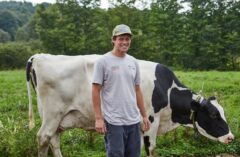
Brian McGarry owns McGarry Dairy with his parents in Berkshire, VT. Photo from Amber Machia.
For smaller farms, like Brian’s, extreme weather can be disastrous. For Brian, significant rainfall events have the greatest impact. Surplus rain dilutes Brian’s manure pit, impacts the farm’s nutrient management planning, and increases the farm’s operating costs. After an extreme rain event, the additional water in the manure means more liquid needs to be spread on the fields to get the appropriate nutrient deposits. This drives up the costs associated with manure spraying, which is charged by volume. To adapt, the farm began a series of drainage projects to control and capture excess water and runoff more effectively.
For cases of drought, the pair formulated a plan to ensure that Brian would be able to get ahead with his forage inventory. Focusing on improving his yields and quality of haylage before a drought. They hoped that by increasing his forage quality and quantity, they would be able to reduce the negative impacts a drought would have on the farm. Since their partnership, Brian has also considered how he could implement double cropping as another way to improve yields.
While it is still too soon to know the long-term impacts of these changes, the pair are glad to have been able to address climate concerns through Dairy CAMF. “The best thing about the program was having the opportunity to hear from a diverse group of farms about their climate concerns, goals, and plans for making progress,” Amber shared. Having learned new information about climate change and the dairy industry, Amber has gotten involved in new climate adaptation projects in her extension work, sharing what she learned while working with Brian. Today, Amber is sharing her new knowledge with Ben & Jerry’s on a three-year pilot program to reduce the carbon footprint of Vermont dairy farms by fifty percent.
Climate Adaptation and Mitigation Fellowship (CAMF) is a program of Cornell University and the USDA Northeast Climate Hub. It supports farmers with climate adaptation and mitigation strategies. The program trains farmers and ag advisors to develop and implement resiliency plans for their farms.
Read the full story: Amber Machia Success Story